International Law and the Making and Breaking of Hegemony
8 July 2026
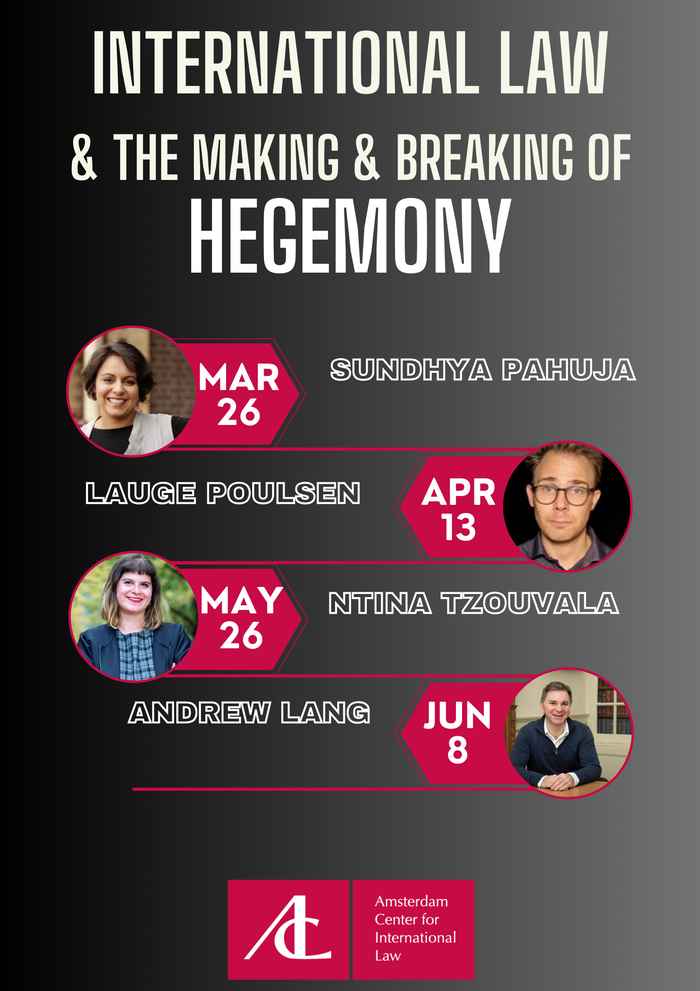
The series lecturers were Sundhya Pahuja (University of Melbourne), Lauge Poulsen (University College London), Ntina Tzouvala (UNSW Sydney), and Andrew Lang (University of Edinburgh). The lectures addressed, and fostered debate on, the relationship between law and global power, examining the legal dynamics through which international law crafts, reproduces, and challenges hegemony.
Metastatic Legality: Companies, States and the Spread of European Law
(26 March 2026)
Professor Pahuja investigates how European law acquired a monopoly over legality on the international plane, and how this monopoly is maintained into the present. She argues that the company is crucial to the answer. More specifically, she locates VOC and its early adventures in Asia in a longer story about the malignant spread of European law through the company-state relation, and the violent displacement of its rivals.

Double Standards of Compensation
(14 April 2026)
The lecture held by Professor Poulsen centred on the international law on property protection seen through the lens of distributive justice. He referenced internal British government records from the Cold War, highlighting that, while the UK demanded developing countries to follow the international standard on compensation for expropriation, they did not follow the same standard at home.
New Tasks and New Forces: International Legal Thought after Neo/Liberal Legalism
(26 May 2026)
Throughout this lecture, Professor Tzouvala addressed foundational questions for the contemporary practice of international law. These included: why did the US turn against the international legal order that had ushered into existence after WWII, particularly after the 1990s? And what were the material and ideological factors that brought the seemingly inexorable march toward the legalisation of global capitalism to an end?
Making Market Infrastructures
(8 June 2026)
Over the last four decades, we have witnessed an extraordinary historical experiment in the making of global markets. This was, in part, a legal experiment, entailing the construction of new legal and regulatory market infrastructures and the mobilisation of new legal technologies. In his lecture, Professor Lang asks us to take another look at this period to better understand the international legal constitution of global markets. In doing so, he offers an alternative view of the present period, in which international law is both in a state of rupture and constitutive of that rupture's conditions of possibility.